
Whitney Westrope
Professional Portfolio
Engage in professional learning
6.4 Apply professional learning and improve student learning
Demonstrate an understanding of the rationale for continued professional learning and the implications for improved student learning.
Viewing children as “active agents and insightful contributors” (Barblett, Barratt-Pugh & Ruscoe, 2018) is a statement that intrigued my interest and prompted me to pose the questions… “how exactly do we share the power with children we teach?” and “how does this impact on their capacity to learn”?
The word ‘power’ is one that I have not thought deeply about in relation to children’s learning, but it is one that is now at the forefront of my mind. Power reveals children’s existing agency and gives them the voice to discern what they feel is important when it comes to learning (Barblett, Barratt-Pugh & Ruscoe, 2018). Although children “recognise their rights to participate in decisions that affect them, including their learning” (DEEWR, 2009, p.9), as an Early Childhood educator, I have not always heard their voices or taken into account the power they possess in regards to guiding their learning.
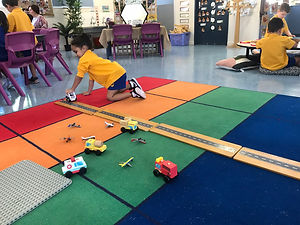
For most of my teaching career, I set up our learning centres and displayed the ‘activities’ I believed the parents should see. I have now come to realise that it is more about the process rather than the product. It is about the interactions we have, the conversations and the spontaneous play that occurs that allows for the learning to take place. We still do have craft and play experiences that allow for a product to show parents, but they are also shown all the other learning that takes place through 'Seesaw' and photos displayed around the room. We have now also co-construct our learning centres/investigation tables so that they were more inclusive of interests and abilities. This can be seen with the pictures belong of our airport (transport and vehicle interest) and cutting and gluing station.
This reading has allowed me to see that we need to foster and connect with the rights of the children we teach and give them the opportunity to articulate their thoughts and decisions. If this can be done in even just a small way, our students will actively engage and guide the learning so that all involved will feel confident in their capabilities. I was able to implement this in our Kindergarten classroom when the children asked "what other cars and things can go fast?" We then looked at and played with trains, planes, tractors and other emergency vehicles.
Barblett, Barratt-Pugh & Ruscoe (2018) have concluded through their study of children’s perceptions of learning that they see learning as holistic and closely connected to a positive disposition. They articulate that learning requires them to be positive, think for themselves, listen and observe. If I can continue to see children as active agents in the learning process and ‘share the power’, the children will continue to have a positive mindset about learning and over time become more independent.
Another part of my Professional Learning Plan involves participating in a PD that would give me more of an idea as to how to implement more agency into my classroom. Here is an outline of the PD which is on the 15th of September 2021.
Title: Agency – Involves educators taking a step back and critically reflecting on, “Do I need to decide for children”?
Rationale: Having agency means “being able to make choices and decisions to influence events and to have an impact on one's world.” As children develop a sense of agency, they realise that they have the ability to make their own decisions and to control their own lives.
Content: Sense of agency refers to how we are in control of our behaviour and thoughts. So, do we encourage and support this with children? Do we allow children to make choices such as what they would like, how much they would like to eat, do we allow them to make choices about friendships or do we impose the unrealistic social rule of “we are all friends here? Do we truly provide choices or are choices available within educator parameters? For example, within the creative arts area are children able to design and make what they like, however only with the resources chosen for them.
This PD would allow me critically reflect on the learning that takes place in my classroom and implement strategies to allow for even more agency to occur. I feel that I allow for some choice within the learning that occurs but I don't feel that this is enough. As it mentioned in the outline, agency does not just allow for choice in the creative arts with set materials but it should allow for more choice outside the educator parameters.
The last part of my Professional Learning Plan involves reading a blog and listening to a podcast regarding the topic of agency, hearing the voices in our classrooms and providing play opportunities that take those voices into consideration not just on a superficial level.
The blog and podcast allow us as educators to look deeper into two topics: Agency and Voice. It outlines that agency is the ability of the child to actively influence their environment – as a learner, a player, singer, an artist and for children, voice is the way they exercise their agency. It seems that voice itself is not enough. We need to consider the space, audience, influences as well as voice as these all advocate for more choice in the learning that takes place.
I feel the most powerful word mentioned in this blog is 'advocacy' and educators being the biggest advocates for students learning. We need to be not only in some way, the voice of the children we teach but also think about who is listening to the students, where are we listening to them and what are we doing about what we have heard?. The 'influence' sector of agency is still hitting a barrier. We need to ensure that not only are the students views being appropriately dealt with but were they taken seriously by those who have the power to affect change.



![20210614_083129[5877].jpg](https://static.wixstatic.com/media/7e5502_e8816f17c5f0434db7ec31cc9d49f3b2~mv2.jpg/v1/fill/w_300,h_225,al_c,q_80,usm_0.66_1.00_0.01,enc_avif,quality_auto/20210614_083129%5B5877%5D.jpg)
EYLF Outcomes: 3.1.7, 3.1.10, 3.2.11
NQS Quality Areas: 2, 6 & 7
Domains: Personal, social, emotional, linguistic, moral, physical.