
Whitney Westrope
Professional Portfolio
Assess, provide feedback and report on students learning
5.2 Provide feedback to students on their learning
Demonstrate an understanding of the purpose of providing timely and appropriate feedback to students about their learning.
In the early years, instant verbal feedback is an essential part of the learning process. As the students do not complete written assessments, this type of feedback allows educators to model positive re-enforcement and give constructive feedback. Educators can also give physical non-verbal feedback which allows students to physically see how to complete an action such as cutting or holding a pencil as well as develop the students positive sense of self by using calm or energetic facial expressions.


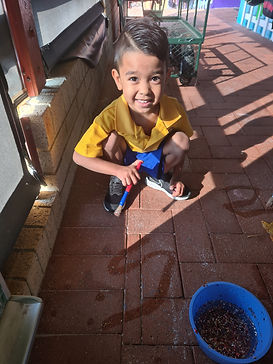
In each of these experiences, the students were able to be given verbal feedback on their pronunciation of the 'Ss' sound as well as the starting point of the pencil or paintbrush when forming the letter 'Ss'.
During the cutting activity, I was able to verbal feedback on where to start cutting as well as remembering to have our thumb to the sky rather than cut using a diagonal grip. I was physically able to show the student what this looks like as he was completing the task in real time rather than afterwards when it wouldn't have had as much meaning.

One example of being able to give instant feedback to the students as they are completing a task is through a Seesaw phonics sound task. The children are asked to place the pictures into the square if it starts with a particular sound. They are guided through the activity and are scaffolded if they are unsure. They are given instant feedback as to whether the picture begins with that sound and are given opportunities to try again if they are not correct.
EYLF Outcomes: 1.1.2, 1.2.9, 3.1.7
NQS Quality Areas: 1, 3, 4 & 5
Domains: Physical, social, cognitive, linguistic