
Whitney Westrope
Professional Portfolio
Assess, provide feedback and report on students learning
5.1 Assess student learning
Demonstrate understanding of assessment strategies, including informal and formal, diagnostic, formative and summative approaches to assess student learning.
.png)
This assessment checklist was completed earlier in Term 1. The students were asked to cut out the mouth of a paper plate fish or a section of a fish template. This experience linked in with our topic of settling into Kindy life and making choices that helped our friends.
It indicates those students who needed assistance to cut and how much assistance was given. This included verbal scaffolding or physical assistance (hand over hand). It allowed us to see the children's grip (thumb to sky or inward) and their strength. We were also able to see who used a helper hand and who did not use their other hand at all. The students were given verbal and physical feedback when cutting to allow correct techniques to be modelled.
.png)
.png)
.png)
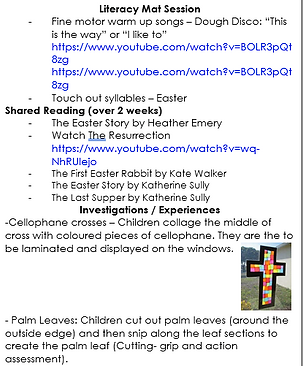
Various experiences were then intentionally planned for the children to practice their cutting and fine motor skills. These activities were both teacher directed and independent to allow the students to practice with guidance and scaffolding and also independently practice without teacher input.
.png)
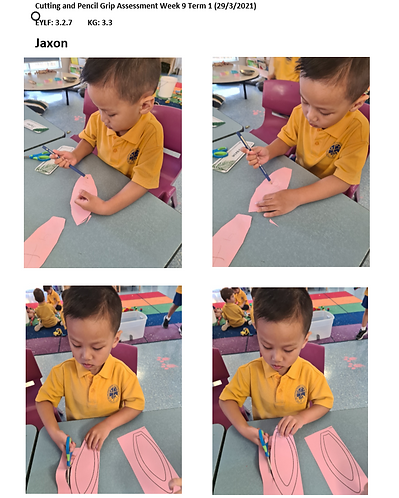
Towards the end of the term, we re-assessed the students on their cutting skills as well as pencil grip. This time as well as checklist documenting the children's grip, strength and position, photos were also taken to visually represent the grip and action. These were used to show parents in end of term interviews the progress their child had made and what scaffolding would taken place to allow them to progress further.
EYLF Outcomes: 4.2.5, 4.3.2
NQS Quality Areas: 1, 5 & 6
Domains: Personal, physical, cognitive.
.png)