top of page

Whitney Westrope
Professional Portfolio
Know the content and how to teach it
2.5 Literacy and numeracy strategies
Know and understand literacy and numeracy teaching strategies and their application in teaching areas.
Literacy and Numeracy in the early years needs to be at the hands on, authentic, engaging and at the point of need. In Kindergarten, we use many strategies to engage and motivate our little learners. These strategies allow for independent exploration or targeted intentional teaching and is done in small groups, one on one or as a whole class.

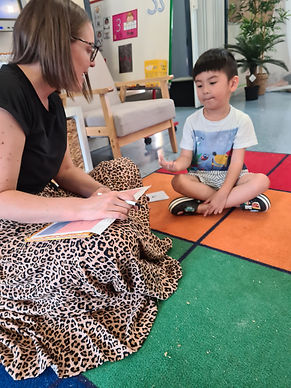

During this experience, I asked the students to show me the numbers 2, 3, 4 and 5 using their fingers. To extend, I asked them to show me in a different way as well as using 2 hands. I allowed time for them to think about how they were going to show me as well as guiding them with questions and statements such as "how many can you see?", "lets count them together" and "would you like me to show you with my fingers?". For those who were identified as not being able to show any numbers using their fingers, more one on one time was allocated to help develop this skill as well as time incorporated in the mat session to consolidate. Later in the term, we developed this concept further by using blocks and drawing a collection to show the number.

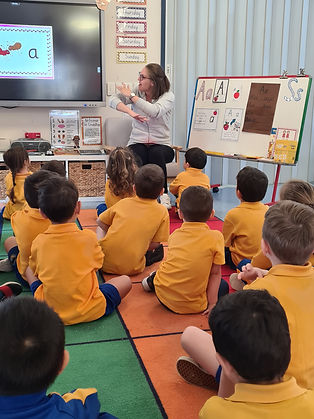
Whole class intentional teaching is also used within our Kindergarten classroom and allows for explicit teaching of certain concepts to be taught. These include number recognition, counting (1:1, ordinal, forwards and backwards), subitising and writing of letters and numbers. We also use songs and actions during these times particularly when focusing on a particular number or sound. The students are given opportunities to copy after a sound or action has been modelled as well as physically practice, listen to and visualise a concept.


Investigation areas and independent play experiences are also used to explore concepts and these allow for the children to gravitate towards the experiences that speak to them the most and develop their understanding of the concept further. We also allow for guided practice with skills such as writing, cutting and oral language and this is done in small groups or one on one.
EYLF Outcomes: 5.2.5, 5.4.4, 5.4.5, 5.4.7, 5.4.10
NQS Quality Areas: 1, 3, 4 & 5
Domains: Physical, cognitive, linguistic.

bottom of page